
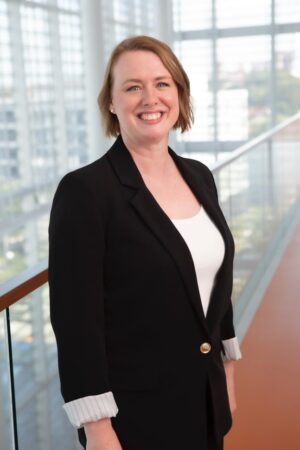
Assistant professor
Contact details (Research)
Centre for Interdisciplinary Research in Rehabilitation of Greater Montreal (CRIR)
Institut de réadaptation Gingras Lindsay de Montréal (IRGLM)
6300 Avenue Darlington
Montréal (Québec) H3S 2J4
Contact details (School of Rehabilitation)
T 514-343-6111 # 30987
marika.demers@umontreal.ca
Program
Occupational therapy
Education
- B.Sc., Occupational therapy, Université de Montréal (2008)
- M.Sc., Readaptation sciences, McGill University (2014)
- Ph.D., Readaptation sciences, McGill University (2019)
- Post-doctorate, Biokinesiology and Physiotherapy Division, University of Southern California (2019-2022)
Current research projects
- Effectiveness of developing a dance version of the GRASP program (GRASP-dance)
- Piano training to better cope with multiple sclerosis
- Training to make piano teaching more inclusive
- Soft robotic exoskeleton for sensorimotor hand rehabilitation after a stroke (CVA)
- Use of inertial sensors for assessment and treatment of upper limb motor impairments after a stroke
- The CIME Upper Limbs Program: Development and implementation of an Intensification and Neuromodulation Clinic for individuals with spinal cord injuries
Selected publications
- Demers M, Hoang Quang N, Chesné L, Sinha S, Dubé N, Bourgeois H, Zidarov D, Meftah EL, Desbarbieux AC, Restout J, Law NY, Ceglia A, Barthélemy D, CIME upper limb rehab team (2026). Combined activity-based therapy and transcutaneous spinal cord stimulation as an intensification and supplemental approach for upper limb sensorimotor recovery: a randomized control trial protocol for in-patients with subacute spinal cord injury. BMJ Open. 16 : e117320. doi:10.1136/bmjopen-2026-117320.
- Demers M, Thean Louis Jean M, Keliny R, Trudelle S, Eng J, Leduc D, Pohjola H, Rochette A, Beaudry L. (2026) Adaptation of the Graded Repetitive Arm Supplementary Program (GRASP) in a danced version: a co-creation project. Arts and Health (accepté le 21 janvier 2026. Sous presse). Doi : 10.1080/17533015.2026.2621656
- Demers M, Winstein C. (2026) Neurorehabilitation needs a qualitative perspective. Frontiers in Neurosciences, numéro spécial Women in Neurosciences. 20, 1707789 Doi : 10.3389/fnhum.2026.1707789
- Cain A, Gunby T, Winstein C, Demers M. (2025) Integration of wearable technology into stroke rehabilitation: rehabilitation researchers’ perspectives. Disability and Rehabilitation : Assistive Technology. 20(5) : 1460-1469 Doi : 10.1080/17483107.2025.2459326
- Demers M, Charalambous M, Kwah LK, Thilarajah S, Bazadona D, Chapman S, Nasreldein A, Yperzeele L, Amoah D, Winstein C, Bernhardt J, Gopaul U. (2025) The unique needs and challenges experienced by young people with stroke: an international qualitative analysis. Neurology: Clinical Practice. 15(1):e200406. doi: 10.1212/CPJ.0000000000200406.
- Demers M, Cain A, Bishop L, Gunby T, Rowe J, Zondervan D, Winstein C. (2023) Understanding preferences of stroke survivors for feedback provision about functional movement behavior from wearable sensors: a mixed-methods study. J Neuroeng Rehabil. 20: 146. DOI: 10.21203/rs.3.rs-2789807/v1
Research interests
- Assessment of upper limbs
- Mechanisms underlying motor recovery after stroke
- Interventions using innovative rehabilitation approaches
- New technologies in rehabilitation
- Stroke